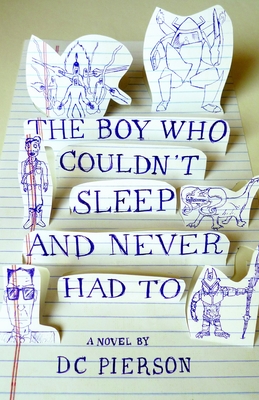
If you never had to sleep just think of all the things you could do. If you didn’t get tired but could stay up all night to do whatever you wanted, what would you do? Oh the possibilities. Think of all those things you’ve wanted to do but didn’t because you were just too exhausted. Well, 15 year old Eric Lederer has lived one consecutive day, never sleeping, always conscious, for as long as he can remember. But someone dangerously mysterious comes looking for him.
Pierson’s novel is hilarious. I laughed. My husband laughed at the quotes I read him. Written from Darren’s perspective (Eric’s best friend) the novel captures the daily lives of two nerdy, sci-fi loving teenagers. I enjoyed Darren’s reactions to Eric’s secret ranging from disbelief to awe. This novel felt really present to me. Pierson is able to capture suburban culture very well perhaps, I think, because he is such a young writer. It’s like he speaks my language (culturally speaking). The Boy Who Couldn’t Sleep explores all the aspects of an average young adults’ life as well as some unusual ones. I could relate to the Red Bull chugging, video-game playing, suburban existence of these kids. Ultimately, I think Pierson’s novel is a coming of age story about friendship.
This is a very 21st-century novel. The text is graphic at least twice about sex. The language is very colorful. And drugs are involved in their attempts to test Eric’s sleepless limits. I’ll have to say that I am usually pretty turned off by these elements. And the text would have been great without the raciness because there is a good story to tell. But Pierson is a great writer and doesn’t use language and sex in a merely gratuitous way. It feels like a natural part of these boys’ lives, like what many teenagers do and witness, as they stumble along the growing up cycle. This is not a YA book, isn’t marked as one, and so I don’t recommend it for young teens lest you hand it to yours and become shocked by what your kids start saying. It makes me sad because this book is so funny. But there you have it.
My favorite part of this book (besides the humor) is the creative story-line. This kid really never sleeps and it leads to a whole lot of wild and bizarre adventures across the Arizona desert. My least favorite part was the ending. It wasn’t bad just not what I wanted/expected. It reminds me of the end of an X-files episode where Agent Scully effectively debunks the abnormal happening but Agent Moulder finds the wiggle room to still believe. That’s an inadequate analogy but the best I can do without spoiling anything!
Publisher: Vintage Books, 2010 Pages: 227
Rating: 3.5 Stars Source: IC Public Library Recommended Age: 18 and up
Time Out has moved to The Prairie Library (link in sidebar). Time Out will lie mostly dormant until I concoct another use for it. All posts pre 6/10 are also available at my new blog.
Showing posts with label coming of age. Show all posts
Saturday, May 15, 2010
Monday, April 5, 2010
All the Pretty Horses by Cormac McCarthy
All the Pretty Horses is a beautifully written story set at the beginning of the end of two ages – the decline of the cowboy and the end of youth. It is 1949 and John Grady Cole is sixteen, ready to become a man and to put his love of horses to work. To do so, he and his seventeen-year-old friend, Lacey Rawlins, saddle-up and leave their Texas homes behind them in search of ranch work in Mexico. Of course, things aren’t always as simple as we think they should be. It isn’t for these boys either.
Reading the description, I thought this novel was as a bildungsroman, or coming-of-age story, in which the protagonist goes through a tough time to learn valuable lessons which enable him to become an adult. Such stories often include a romantic relationship which helps to achieve this end. But while reading, I felt John Grady was already an adult. This kid knows his mind and how to handle himself. He is already equipped with a trade (braking horses) and is darn good at it. I’m thinking of Dickens’ Great Expectations, often considered a bildungsroman. Pip goes through much to grow up and I don’t think the pattern is the same for John Grady. John is perhaps reckless but not immature. He falls in love but is not a hopeless romantic like Pip. Having finished reading, I will concede this as a coming-of-age story because John undergoes a shift in the way he understands the world. He acquires a more “grown up” perspective. He always tries to do what he thinks is right but still struggles with his conscience. Finally, John recognizes that not everything in life can be explained and rationalized, that all events in life can’t be nicely wrapped up as we would like. More than the physical events that John experiences, it is this mental growth that signals adulthood. For me, watching how John processed his actions was as motivating to turn pages as reading for the plot.
I am a huge fan of McCarthy’s unconventional writing style. I’m amazed at his command of language and find his writing beautiful and inspiring. This is a text to take your time with, to enjoy the language and visualize what is being described. The descriptions are out of this world if you will allow yourself to sink into the text and not worry about finishing and finding out what happens. This is an “enjoy the journey” book and is not about getting to the end but appreciating the steps that lead to it. I realized on page one that I would have to slow down. I’m glad I did. Here’s an example of a description:
Shrouded in the black thunderheads the distant lightning glowed mutely like welding seen through foundry smoke. As if repairs were under way at some flawed place in the iron dark of the world. (McCarthy 67)
Wow, I just love that. I had to read it four times, once out loud to my husband, and we gushed about it (much like I’m doing now). It just so happens to be storming outside right now, too, and that’s just how the lightning is. On another note, I enjoyed the Spanish mingled throughout the text and was surprised at how much I remembered from class. But if you don’t know Spanish don’t worry as the text is 98% English.
Every time I opened this novel, I felt completely transported to the West. It was like I was hanging in the clouds watching John Grady ride his horse. I think that’s why I enjoyed this book so much. This is book one of the “Border Trilogy” but All the Pretty Horses stands well on its own. If I didn’t know there were more books I would have thought it was a standalone novel. Book two will be in my reading list for the future.
Publisher: Vintage, 1993 Source: IC Public Library
Rating: 4 Stars Pages: 301
Reading the description, I thought this novel was as a bildungsroman, or coming-of-age story, in which the protagonist goes through a tough time to learn valuable lessons which enable him to become an adult. Such stories often include a romantic relationship which helps to achieve this end. But while reading, I felt John Grady was already an adult. This kid knows his mind and how to handle himself. He is already equipped with a trade (braking horses) and is darn good at it. I’m thinking of Dickens’ Great Expectations, often considered a bildungsroman. Pip goes through much to grow up and I don’t think the pattern is the same for John Grady. John is perhaps reckless but not immature. He falls in love but is not a hopeless romantic like Pip. Having finished reading, I will concede this as a coming-of-age story because John undergoes a shift in the way he understands the world. He acquires a more “grown up” perspective. He always tries to do what he thinks is right but still struggles with his conscience. Finally, John recognizes that not everything in life can be explained and rationalized, that all events in life can’t be nicely wrapped up as we would like. More than the physical events that John experiences, it is this mental growth that signals adulthood. For me, watching how John processed his actions was as motivating to turn pages as reading for the plot.
I am a huge fan of McCarthy’s unconventional writing style. I’m amazed at his command of language and find his writing beautiful and inspiring. This is a text to take your time with, to enjoy the language and visualize what is being described. The descriptions are out of this world if you will allow yourself to sink into the text and not worry about finishing and finding out what happens. This is an “enjoy the journey” book and is not about getting to the end but appreciating the steps that lead to it. I realized on page one that I would have to slow down. I’m glad I did. Here’s an example of a description:
Shrouded in the black thunderheads the distant lightning glowed mutely like welding seen through foundry smoke. As if repairs were under way at some flawed place in the iron dark of the world. (McCarthy 67)
Wow, I just love that. I had to read it four times, once out loud to my husband, and we gushed about it (much like I’m doing now). It just so happens to be storming outside right now, too, and that’s just how the lightning is. On another note, I enjoyed the Spanish mingled throughout the text and was surprised at how much I remembered from class. But if you don’t know Spanish don’t worry as the text is 98% English.
Every time I opened this novel, I felt completely transported to the West. It was like I was hanging in the clouds watching John Grady ride his horse. I think that’s why I enjoyed this book so much. This is book one of the “Border Trilogy” but All the Pretty Horses stands well on its own. If I didn’t know there were more books I would have thought it was a standalone novel. Book two will be in my reading list for the future.
Publisher: Vintage, 1993 Source: IC Public Library
Rating: 4 Stars Pages: 301
Friday, March 5, 2010
Persepolis II: The Story of a Return by Marjane Satrapi
In Persepolis II, Marjane’s parents send her to Vienna where she lives by herself and grows up quickly. It is an extremely difficult time for Marjane. After four years, she returns to Iran at age 18 with emotional baggage and conflicted feelings. In this poignant sequel, Marjane is a woman of two worlds, feeling western and Iranian but not fully accepted by either culture.
Persepolis II highlights the subjugation and chauvinism exuded by the state that makes it hard for free thinkers to live in Iran. Although the war with Iraq is over, fear is ever prevalent as Marjane and her friends dodge the “guardians of the Islamic revolution.” Marjane struggles to find companions with similar ideologies and often feels alone. This text shows how precious our freedom of speech is as we watch Marjane become paranoid about how she speaks, dresses and draws advertisements for work.
Book two is much more serious as Marjane deals with the burdens of adulthood. She turns to radical friends, smoking, drinking and relationships in an attempt to find a place and purpose for herself. It is her strong will that keeps her going, but even her will wavers when she experiences a severe depression leading to an attempted suicide. As she realizes the extent of the state’s control over her life, Marjane’s perception of and hope in her country changes. I found Marjane’s story to be captivating. She has lead a challenging life to say the least. Her memoir allows readers a peek into a very conservative and foreign culture and how many people there continue to hope for change and peace.
Publisher: Pantheon, 2004 Recommended Age: 15 and up
Source: IC Public Library Pages: 187
Rating: 4 Stars
Persepolis II highlights the subjugation and chauvinism exuded by the state that makes it hard for free thinkers to live in Iran. Although the war with Iraq is over, fear is ever prevalent as Marjane and her friends dodge the “guardians of the Islamic revolution.” Marjane struggles to find companions with similar ideologies and often feels alone. This text shows how precious our freedom of speech is as we watch Marjane become paranoid about how she speaks, dresses and draws advertisements for work.
Book two is much more serious as Marjane deals with the burdens of adulthood. She turns to radical friends, smoking, drinking and relationships in an attempt to find a place and purpose for herself. It is her strong will that keeps her going, but even her will wavers when she experiences a severe depression leading to an attempted suicide. As she realizes the extent of the state’s control over her life, Marjane’s perception of and hope in her country changes. I found Marjane’s story to be captivating. She has lead a challenging life to say the least. Her memoir allows readers a peek into a very conservative and foreign culture and how many people there continue to hope for change and peace.
Publisher: Pantheon, 2004 Recommended Age: 15 and up
Source: IC Public Library Pages: 187
Rating: 4 Stars
Labels:
coming of age,
graphic novel,
Islam,
memoir,
nonfiction,
YA,
young adult
Thursday, March 4, 2010
Persepolis: The Story of a Childhood by Marjane Satrapi
Marjane Satrapi chronicles her life when growing up during the Islamic revolution. When the Shah is overthrown Marjane and her family are overjoyed but soon realize that their hopes for liberty are being thwarted by a new and powerful regime. While she and her family hold onto their freedom (with clandestine card parties and music bought from the black market) the war with Iraq breaks out, increasing tensions among Iranians as they fight over religion and food supplies. From the innocent and often naïve perspective of childhood, Satrapi presents a dissident voice during a troubling time.
Can one be patriotic and dissident at the same time? The Satrapi family loves their country so much they do not want to leave despite the increasing violence and subjugation. They love their culture, friends and family and feel their life in Iran is better than what it could be anywhere else, including the United States. They want to make their home a better place by staying rather than leaving. It is the people that define a nation and Marjane’s parents want to be a part of that definition. Despite the context she grows up in, Marjane is a typical teenager who wants to go to parties and listen to popular music. Marjane is resilient after all she sees and experiences during protests and war. Seeing Marjane as a typical kid should make it easier for U.S. kids to identify with her and put themselves in her shoes and to ask how they would have felt if they were Marjane’s maid, neighbor or if they were Marjane herself.
I read this book in one sitting and enjoyed it a lot. The text offered an inside perspective of a third-world country that I would likely have never seen otherwise. It shows us what it was/is like for women who are forced to wear the veil. Marjane’s spunky attitude kept me hooked. It was amazing that she never asked the reader for sympathy or pity but to simply listen to her story. She just wants her side of the story, the unheard part of the truth, to be told.
Publisher: Pantheon Books, 2004 Source: IC Public Library Pages: 160
Rating: 5 Stars Recommended Age: 13 and up
Can one be patriotic and dissident at the same time? The Satrapi family loves their country so much they do not want to leave despite the increasing violence and subjugation. They love their culture, friends and family and feel their life in Iran is better than what it could be anywhere else, including the United States. They want to make their home a better place by staying rather than leaving. It is the people that define a nation and Marjane’s parents want to be a part of that definition. Despite the context she grows up in, Marjane is a typical teenager who wants to go to parties and listen to popular music. Marjane is resilient after all she sees and experiences during protests and war. Seeing Marjane as a typical kid should make it easier for U.S. kids to identify with her and put themselves in her shoes and to ask how they would have felt if they were Marjane’s maid, neighbor or if they were Marjane herself.
I read this book in one sitting and enjoyed it a lot. The text offered an inside perspective of a third-world country that I would likely have never seen otherwise. It shows us what it was/is like for women who are forced to wear the veil. Marjane’s spunky attitude kept me hooked. It was amazing that she never asked the reader for sympathy or pity but to simply listen to her story. She just wants her side of the story, the unheard part of the truth, to be told.
Publisher: Pantheon Books, 2004 Source: IC Public Library Pages: 160
Rating: 5 Stars Recommended Age: 13 and up
Labels:
coming of age,
graphic novel,
Islam,
memoir,
nonfiction,
survival,
YA,
young adult
Subscribe to:
Posts (Atom)